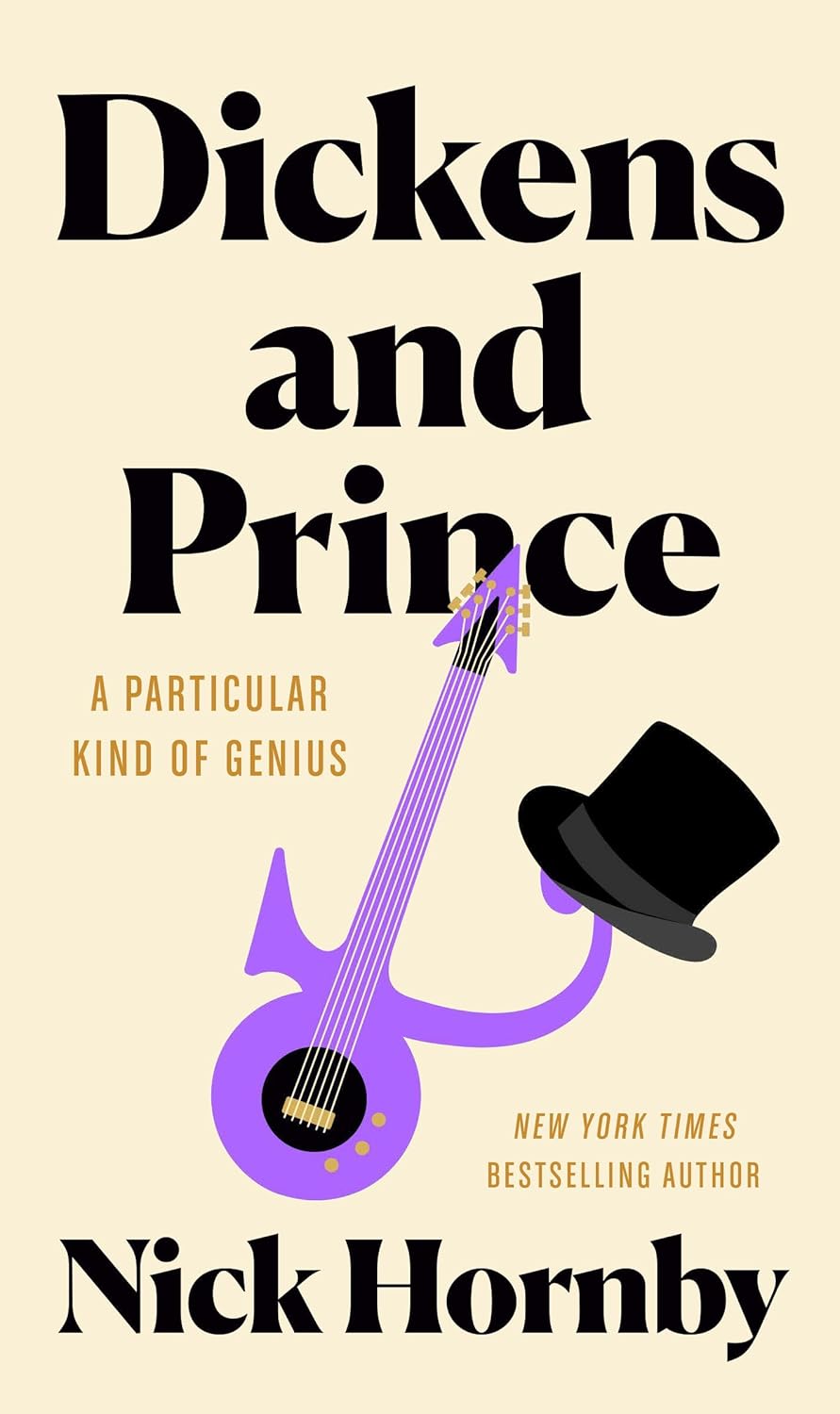

Maybe there were other people who were just as prolific, although I doubt it, especially since Prince did a lot more than just record, and Dickens did a lot more than simply write novels. But I yoked them together in my mind at that moment because they are two of what I shall have to describe, for want of a more exact term, as My People—the people I have thought about a lot, over the years, the artists who have shaped me, inspired me, made me think about my own work…. Anyone who has spent a lifetime consuming culture in all its forms at a possibly unhealthy rate has a similar list. Nick Hornby, Dickens and Prince: A Particular Kind of Genius
Call it paranoia, but the last sentence of that quotation from Nick Hornby’s extended juxtaposition Dickens and Prince feels like a gauntlet drop aimed at me personally. For one thing, Hornby has clearly intuited that he himself once occupied a prominent spot among My People. For another, my inner narcissist can’t conceive of another reason to write a 159-page Venn diagram whose concentric circles overlap so narrowly that the exercise initially seems pointless. In one circle sits Charles Dickens, master of Industrial Revolution page-turners and character name inventor extraordinaire. (Has any writer been so unfailingly gifted at nomenclature? From Canon Crisparkle to Mister Sweedlepipe, Mrs. Kidgerbury to Master Bates—okay, perhaps not “unfailing.”) In the other circle sits Prince, the master funk-pop innovator who told the global media, “my name is now a symbol I made up,” to which the global media obsequiously replied, “As you wish, Mr. Symbol.” That anachronistic pairing converges precariously on a few superficial similarities and two that really count: their shared membership in Nick’s Hall of Influences and their pathological productivity. Hornby suggests that the raw tonnage of artistic output produced by the Oliver Twist author and the Purple One may be weightier than that of any other pair in cultural history. “Maybe you are reading this and shouting, Wagner! Picasso!” he writes. “If so, you’ll have to write your own book.” Holy shit, he did it again. Did you hear him? Did you hear him? Oh, the monster overbearing. He is unmistakably triple dog daring me to draw an arbitrary pairing from My People that is more rhetorically fertile for a personal essay than his. Alright, Hornby, you’re on.
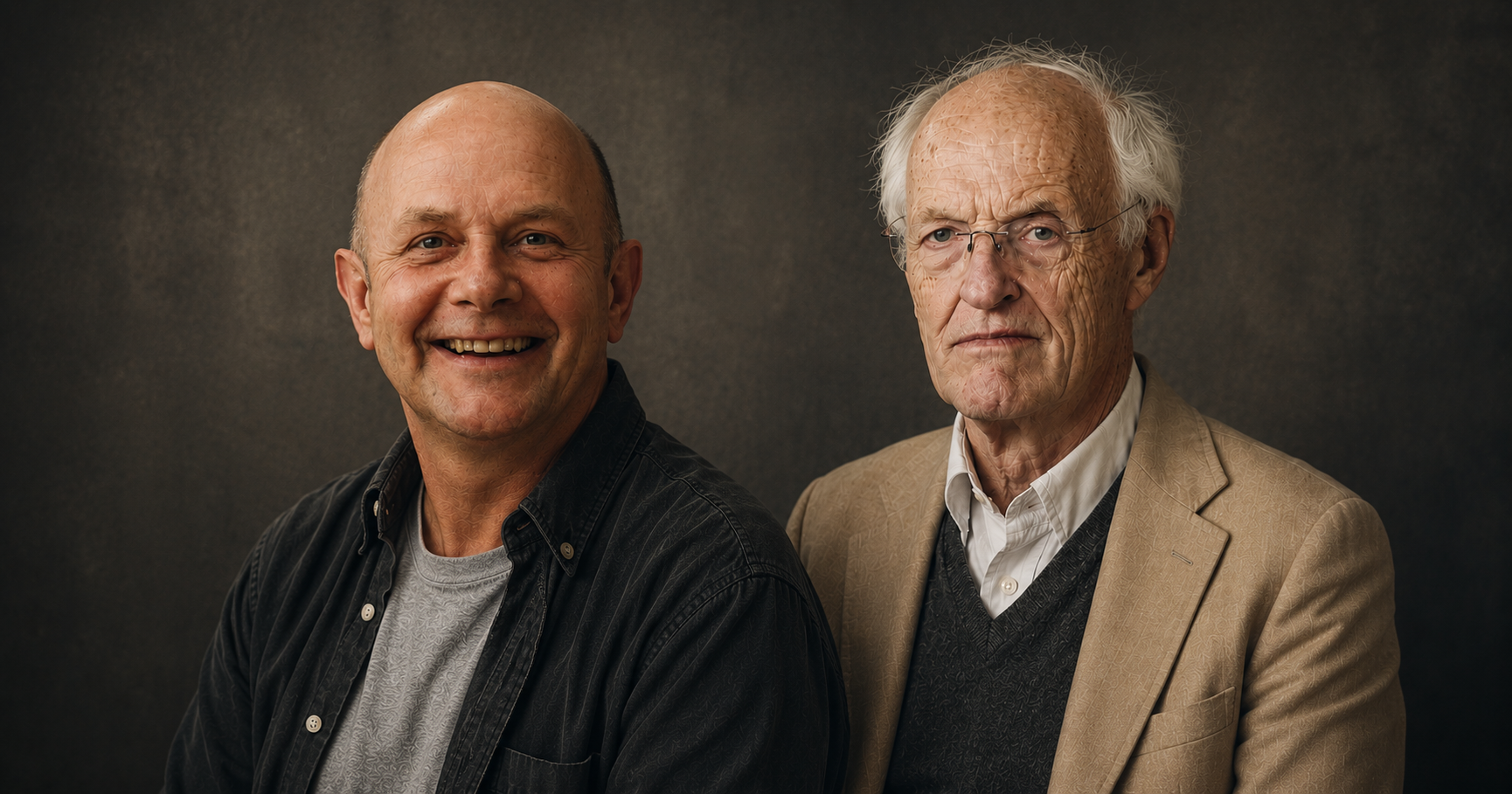
This is a joint appreciation of Nick Hornby, master of novels about shallow lads who fetishize pop culture, and Michael Frayn, master of novels about narcissistic academics who fetishize high culture. At the heart of the comparison is their shared interest in the vast gap between artistic appreciation and artistic labor.
HIGH FIDELITY AND COPENHAGEN
When I was in my twenties, that gap sometimes felt like an unbreachable chasm. If you asked me then how I wanted my personal bildungsroman to play out, I would emphasize my aspirations to secure artistic labor. But like many theater kids at that age, I was unable to confidently identify my artistic niche. Promising enough as a liberal arts graduate to have the pick of the theatrical internship litter, I turned down the Ostentatiously Expanding Enterprise most likely to hire me and signed on with the Struggling Cultural Institution that let me try my hand in the most departments. Dramaturgy was the real lure of that internship, but at the time there were only a handful of paid dramaturgs in the country.
Michael Frayn’s Copenhagen, the first Tony winner I ever saw live, was a dramaturg’s dream. Nestled at the nexus of history, science, and epistemology, the play ricocheted with intellectual energy. I had encountered Frayn as a master of meticulously plotted farces (Noises Off, Chinamen), but he didn’t become one of My People until I read Copenhagen. Quantum physicists Werner Heisenberg and Niels Bohr look back from the vantage of posterity, racking their brains as to why Heisenberg visited Bohr during the German occupation of Denmark. The ghosts reenact their brief and explosive encounter again and again, but the closer they look the more history is contaminated by bias, dogma, longing. This is an anthropomorphic dramatization of Heisenberg’s uncertainty principle, which asserts that, within the atom, observation alters outcome. Quantum physics fiction isn’t unique to Frayn, before or after. Tom Stoppard’s 1988 spy sendup Hapgood uses wave-particle duality to illustrate the human capacity for multiplicity. Benjamín Labatut’s 2021 novel When We Cease to Understand the World plumbs subatomic uncertainty not so much for metaphor as for ghastly post-nuclear atmospherics. Still, Frayn’s treatment blew me away then and took root in the corner of my brain that scrutinizes motivation and intention. It was the kind of play that made me want to be a dramaturg. No, director. No, playwright.
The rudderless drift of my artistic career did not deter my proficiency as a consumer of art. In that respect, I resembled the now-iconic OG shallow lad Rob Fleming in Nick Hornby’s 1995 breakout bestseller High Fidelity, which I read around the same time. Rob and I both enjoyed ranking things. He through endless Top Five lists (best subtitled films, most memorable split-ups, etc.) and I through obsessively researched Oscar Party competitions. He opened his own record shop. I was hired to write album reviews. We both had an overdeveloped capacity for informed artistic appreciation. His artistic ego was wounded when he started dating a singer/songwriter. Mine was wounded with nearly every social encounter. I wasn’t as crass as Rob in my dating life, but I was at least as incompetent at it. I was or I was not ready for commitment, and I did or did not love, and I could or could not envision myself pursuing any other course of action than the one on my plate any given day. My twenties are ongoing in my dreams. I wake up and rack my contaminated memory to pinpoint my past self’s motivations and intentions, but my observations yield only endlessly shifting Heisenbergian uncertainty.
THE HORNBY YEARS AND HEADLONG
By my mid-thirties and forties, I’d settled on a career outside the arts with research duties that led to reading fatigue. That caused me to sacrifice serious reading in exchange for binge watching and never-ending screen time. During that decade, I occasionally opened a book, but I always lazily defaulted to authors I already knew. It was an exceedingly exclusive club of authors, and Hornby ranked at the top. At that point in my life, his familiar Shallow Lad Deepens narrative was intellectual comfort food. Book after book told the same story of superficial people redeemed through human connection. The snarky journalist in How to Be Good is so enamored with the Woke Girl that he eventually becomes good himself. An awkward tween in About a Boy teaches a coasting one-hit wonder how to care again. A mismatched suicidal foursome in Long Way Down restores their desire to live via shared community. A skateboarder in Slam time travels his way to becoming a responsible father. The shallow lads are usually accomplished appreciators of pop culture, but art is supplanted in importance once they achieve the Well Lived Life. In all of that Hornby, I think only Sophie Straw, The Marvelous Mrs. Maisel-esque sixties comedienne in Funny Girl, succeeds as an artistic creator. But by the time I heard that audiobook on a solo road trip to Fort Wayne, Shallow Lad Deepens felt less surprising than the exponentially replicating mile markers on I-69. Hornby’s work is clever and engaging, and each book succeeds on its own terms. But it was time to read somebody else.
My literary exile finally ended during an annual visit to a favorite bookstore, a tradition that somehow survived the reading recession. A copy of Hornby’s State of the Union: A Marriage in Ten Parts was languishing on my nightstand, but I’d seen that couple resort to therapy in the television version, and it had failed to light a spark. Instead, I picked up a Frayn novel that took a troubled marriage narrative in an entirely different direction. The narrator of Headlong is a narcissistic don as bored with teaching the philosophy of Nominalism (the belief that there are no universals) as I was with my repetitive reading life. He is existentially rejuvenated by his delusion (or is it?) that his country neighbor unknowingly possesses a long-missing masterpiece by Dutch painter Pieter Bruegel the Elder, who quietly resisted the religious tyranny of Spain’s brutal 16th-century despot King Philip II. I began reading the book with enthusiasm. And put it down in intellectual exhaustion 20 minutes later. In better times before and after, I would have devoured Frayn’s frisky 344 pages like an airy apéritif. Instead, my atrophied attention span alternated between pathetically brief spurts of momentum and weeks of doomscrolling relapse. Yet curiosity about Professor Martin Clay’s snowballing descent into art-fueled madness kept inspiring a few more reps, a few more reps, a few more reps. Ten months later, Headlong was still on my nightstand. But the last 20 percent was so propulsive that I stayed up all night until I reached the conclusion.
THE TRICK OF IT AND JULIET, NAKED
Three weeks ago, I wrote a review of Toni Morrison’s God Help the Child entitled “In Defense of Latter Morrison.” One critic in particular triggered my defense mechanism. Ron Charles, for 20 years the esteemed literary voice of the Washington Post, employed his prodigious linguistic powers to dispatch the book as “flat” and “clunky.” I didn’t recognize Morrison’s novel in his arch encapsulation, so on my Substack I characterized Charles as “breathtakingly disrespectful” to a “national treasure.” The next day, I spotted a singularly witty post on my Substack feed. It was a rejection of T.S. Eliot’s The Waste Land penned by Amazon’s Jeff Bezos. Snorting gleefully as I seared a salmon filet, I noticed the writer’s name. Ron Charles. Attempting to bookmark the post with my unspatchulaed hand, I accidentally hit “Subscribe.” I am now an (unironically) enthusiastic member of Charles’s 34,000 + subscriber base. Turns out I’d levied a snarky grammar joke at an incisive wordsmith who is a national treasure in his own right. Worse, I did it on his new platform 100 days after he was laid off from his position as one of the nation’s few remaining newspaper book critics. That is an institution that has long been important to me as an appreciator of art.
Frayn’s 1989 novella The Trick of It lampoons literary appraisers so impressed with their own pedantically intoned insights that they become blind to merit. Its narrator, Richard Dunnett, is a verbally precious English lit professor who meets, beds, and marries the novelist he specializes in. The constant conjugal interaction destroys the relationship between critic and writer. No longer the resident expert on his wife’s work, Richard becomes insecure, defensive, and controlling.
A refusal even to consider sympathetic and constructive criticism, it seems to me, is a terrible vote of no confidence in oneself…. I have to give her the confidence to go forward. And I have to do it by shaking her confidence in where she is standing now. That’s the paradox which … is inherent in every teacher’s task, every critic’s role. Michael Frayn, The Trick of It
Richard’s admiration for his wife’s craft devolves into a sulky rejection of fiction itself: “That’s what they do, these people,” he says of novelists. “They embroider, they improve on the truth – they tell lies.” He tries to write his own novel (“any bloody fool can do it”) but eventually must concede that her gifts dwarf his own. For all his rambunctious wordplay, Richard’s erudition masks an underlying banality of artistic thought. He is the prototype of the Fraynian shallow don fetishizing high culture without genuine substance. Frayn’s depiction of Richard punching up at his wife, who is clearly the better writer, feels eerily relevant to my experience punching up at Charles for punching up at Morrison.
Hornby’s 2009 novel Juliet, Naked treads much of the same territory in a pop culture context. The Trick of It is about a professor who meets the author he teaches. Juliet, Naked is about a professor who meets the reclusive rock star he teaches. Unlike Frayn’s, Hornby’s pompous academic doesn’t become romantically entangled with the object of his fanboy obsession. Instead, his live-in girlfriend does. Both works mock the swollen pride obsessive fans and experts often feel in their own artistic interpretations. Both books win laughs by puncturing that pride. My impulse is to crack wise about the redemption that the rock star finds in his relationship with the professor’s ex, but it is a genuinely poignant resolution, and it is always easy to be glib.
Loving art, high or low, is not the same thing as crafting one’s thoughts about art, and analyzing art is not the same thing as creating it. In the last two years alone, I’ve consumed 100 books. Artistic consumption does fuel one’s creative appetite, and now I try to write these essays to ensure I am intellectually engaged with the books. Hell, I write them to make sure I am intellectually engaged with life at all. For a chronic consumer and one-time wannabe creator, that is almost but not quite a Shallow Lad Deepens narrative.
Touché, Hornby.
This essay is in the Booker category because Michael Frayn’s Headlong was shortlisted for the Booker Prize in 1999, and Nick Hornby’s How to Be Good was longlisted for the Booker Prize in 2001.