
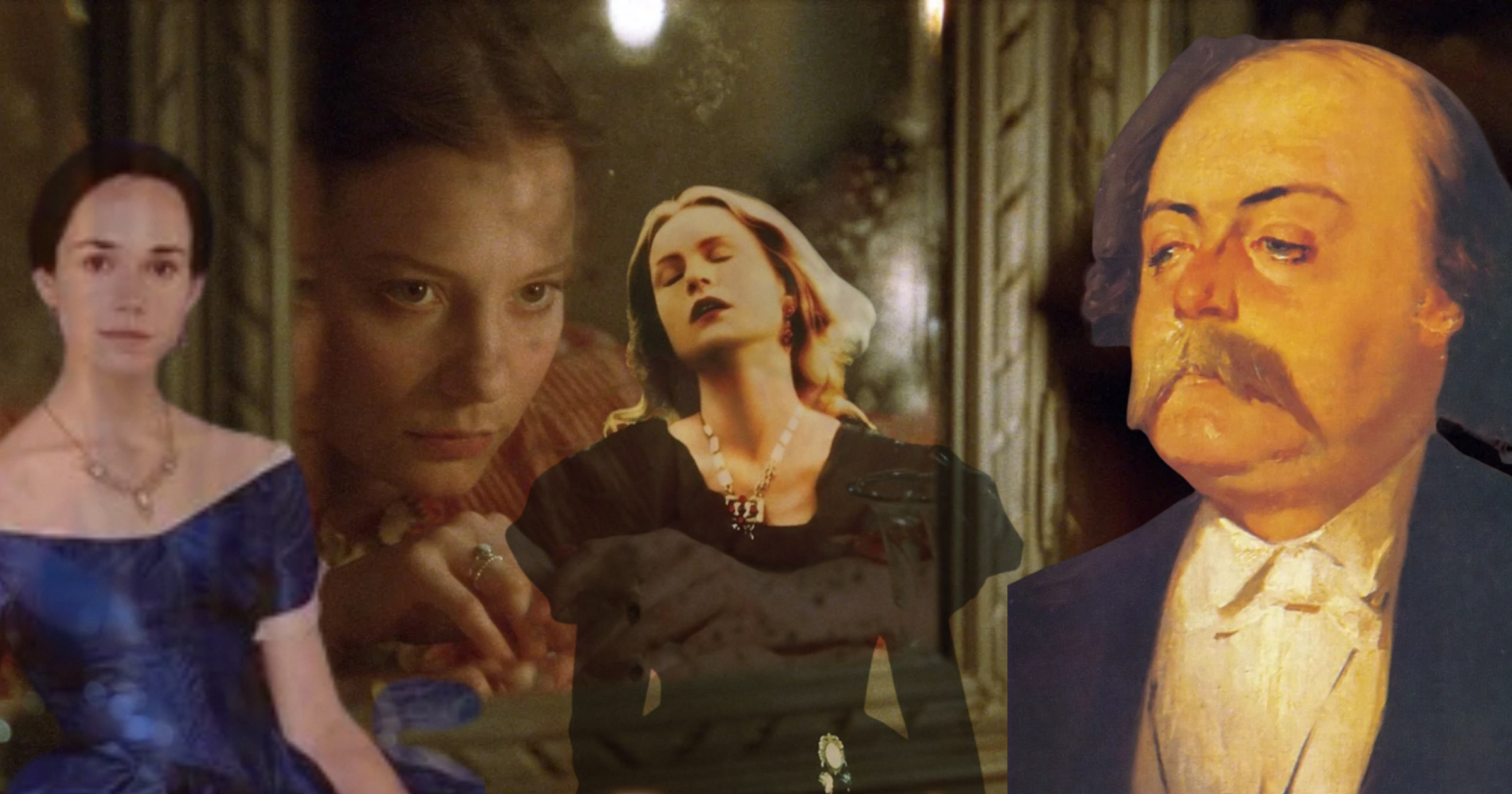
After watching three recent film adaptations of Madame Bovary, I am inclined to think the filmmakers were rigorously faithful to the wishes of Gustave Flaubert. Well, in one very specific way. The filmmakers seem sedulously committed to realizing the author’s most fervent dreams for his 1856 breakout hit’s place in literary history.
In later years Flaubert comes to resent the insistent fame of his masterpiece, which makes others see him as a one-book author. He tells [novelist Maxime] Du Camp that if ever he had a stroke of good luck on the Bourse he would buy up ‘at any cost’ all copies of Madame Bovary in circulation: ‘I should throw them into the fire, and never hear of them again.’ Julian Barnes, Flaubert’s Parrot
That’s right. Gambling Gustave’s explicit ambition for his signature achievement was that it be incinerated in the raging Bonfire of his Vanity. “Bovary bores me, Bovary irritates me, the vulgarity of the subject gives me bouts of nausea,” Flaubert is said by critic Maurice Bardeche to have carped in his letters. Of the novel’s characters, Flaubert groused, “I find them deeply repulsive.”
The three films I endured for this essay—Claude Chabrol’s 1991 Oscar-nominated French-language adaptation, Tim Fywell’s 2000 BBC miniseries, and Sophie Barthes’s 2014 indie drama—are not without their individual virtues, and I was mostly entertained by them. I mean, they did not fill me with the scratch-your-eyes-out odium that Flaubert felt every time the book was casually cited at breakfast. But rest assured, all three are so tonally out of step with their source material that they further the author’s wish for its utter erasure from public consciousness. For if enough members of the dwindling minority who have any inclination to experience the classics watch these travesties and mentally check Madame Bovary off their must-read list, Grouchy Gustave may just get his way.
My personal Bovary film fest left me scratching my head at cinema’s consistent inability to recreate the exquisitely timed caustic irony that is, for me, the novel’s most salient pleasure. Flaubert was forever fascinated by the “stupidity” of humanity; it was perhaps his signature theme. That meant he was willing to laugh, even sneer, at his heroes. “This will be the first time,” he wrote as he was crafting a central romance, “that one will see a book that makes fun of its young leading lady and its young leading man.” The films shove their way into an unending queue of readers who have sympathized with Flaubert’s psychologically complex creations but ultimately refused to fully embrace the abrasive cynicism of his vision. The preeminent critic of Flaubert’s day, Charles Augustin Sainte-Beuve, wrote, “My objection to this book is that the good is too much absent.” Proto-feminist novelist George Sand cautioned Flaubert that “if you show [the reader] the evil coldly, without ever showing him the good, … he wonders if it is he that is bad, or if it is you.” A present-day critical exemplar, James Wood, said Madame Bovary “seems vicious, the ironies suffocating and deterministic, the technique somewhat crudely insistent.” The filmmakers embody this discomfort. They water down Flaubert’s vinegar potency, supplant it with alien Victorian reticence, or drown it in political polemic. None want to risk putting it on the screen.
To measure the irony gap between the adapters and their laugh-out-loud source, I will evaluate each on their success at recreating Flaubert’s three most rapturously “repulsive” creations: Emma’s devoted hubby Charles Bovary, his caddish cuckolder Rodolphe Boulanger, and Emo Emma herself. Then, for my next trick, I will demonstrate that Flaubert’s famous cynicism and his mostly ignored compassion are one and the same novelistic technique. Presto Chango! A la Peanut Butter Sandwiches!
Exhibit A: Charbovari!
We should recall Sainte-Beuve’s complaint against Flaubert: in Madame Bovary “goodness is too much absent.” What!? How about Charles Bovary? Devoted to his wife, to his patients, utterly devoid of selfishness: Is he not a hero, a martyr of goodness? How can we forget him, him who after Emma’s death, now knowing about all her infidelities, feels no anger but only an infinite sadness? … This character so unbelievably, implausibly good and yet so real, he is surely … worthy of compassion. Milan Kundera, The Curtain: An Essay in Seven Parts (Linda Asher, translator)
As much contempt as Emma Bovary has for her obliviously doting husband, Charles may be the character Flaubert was least repelled by. In the introduction to her fetching 2010 English translation of Madame Bovary (the edition I read), Lydia Davis names the dopily kindhearted country doctor as one of a small number of characters who earn “glimmers of sympathy or liking, at moments.” He may be a gormless simp, but at least he genuinely gives a shit.
From the first scene to the last, poor Charles’s tender heart is brutally stomped by the harsher hearts around him. When a teacher demands the “new boy’s” name, Charles blurts out a slurred version of it: “Charbovari." His classmates chant the error mercilessly. His first wife is a frigid shrew whom he escapes only by becoming a widower. Try as she might, his second wife can’t return his credulous affection. “He could not refrain from constantly touching her comb, her rings, her scarf,” we are told by Flaubert’s resolutely unopinionated narrator, “and she would push him away, with a weary half smile, as one does a clinging child.” Her aversion to him grows stronger with time: “His conviction that he was making her happy seemed an idiotic insult, and his certainty of this, ingratitude. … She wished Charles would beat her, so that she could more justly detest him, avenge herself.” If Flaubert quietly sympathizes with Charles, he is nonetheless merciless in plundering his credulousness for comic rewards.
The consummation of Charles’s and Emma’s marriage provides a useful metric for evaluating an adaptation’s fidelity to Flaubert. The novel discreetly omits the honeymoon night, reporting only that Charles “seemed another man” the following morning. “It was he whom one would have taken for the virgin of the day before, while the bride revealed nothing from which one could have guessed anything.”
Chabrol plays the scene more or less by the book. Jean-François Balmer as Charles is decidedly unglamorous and appropriately unctuous and uxorious. He bursts out of their bedchambers the morning after, euphorically demanding breakfast from the servants. It is accurate but dull, just like the movie.
The bizarrely stately BBC version casts the talented Hugh Bonneville (Downton Abbey’s Earl of Grantham) as a quietly longsuffering Charles. He is a little too intelligent and not nearly funny enough. Telewriter Heidi Thomas invents noncanonical scene after noncanonical, and the consummation scene is a doozy. Bonneville thrusts away Emma’s virginity in oblivious ecstasy. “I never knew, Emma!” he cries. She lies prone in pained, philosophical ennui: “Is this passion, Charles? Is this passion?” Thomas gets the relationship dynamic right, but the ponderous tone is more Brontë than Flaubert.
The 2014 Sophie Barthes version burdens the narrative with an unsmiling feminist agenda. Flaubert’s Charles is too nice to accommodate her piercing thesis that Man Bad Woman Good. In the consummation scene, the handsome Henry Lloyd-Hughes is not just oblivious to her feelings, he is almost sinister in his onanistic lack of interest. He plows her, grunts, rolls over, and falls asleep.
Exhibit B: Rakish Rodolphe
Any filmmaker who takes Flaubert seriously has to replicate the tightwire act his cavalier seducer Rodolphe Boulanger walks between credible sex appeal and calculating buffoonery. In the novel, Rodolphe is a 34-year-old ladies’ man of “keen” intelligence. He takes one look at Madame Bovary and instantly sees the whole affair play out from start to finish: “That one’s gasping for love like a carp for water on a kitchen table,” he thinks. “With three pretty compliments, that one would adore me, I’m sure of it. It would be lovely! Charming! . . . Yes, but how to get rid of the woman afterward?”
Rodolphe’s seduction scene, in which the rake plays his angle with a speech about farming protocol in the background (“I couldn’t tear myself away, though I’ve tried a hundred times.” “Manure!”) is a common pick for the novel’s deftest satire. Personally, though, I prefer Rodolphe’s Dear John Letter, a note he delivers by proxy as she is expecting to run away with him. He breaks up with her in ink, and then adds one last note “for fear she’ll come pestering me.” He lies that he must run away anyway just so he isn’t tempted by her. Then he ponders how best to conclude and settles on “Your friend.”
That’s high comedy. And Flaubert has a perfect button for the scene:
“Poor little woman!” he thought with emotion. “She’ll think I have no more feeling than a stone; there should have been a few tears on it; but I can’t cry; it’s not my fault.” Then, having poured some water into a glass, Rodolphe dipped his finger in it and let fall from above a fat drop, which made a pale blot on the ink. Gustave Flaubert, Madame Bovary (Lydia Davis, translator)
If I am a filmmaker adapting Madame Bovary, I am drooling over the comic potential of that material. The BBC seems to agree; Greg Wise’s dashingly serious Rodolphe emotively plucks a rose from a vase and shakes a drop onto his text, writing “My tears stain the page.” But the score’s swelling strings are busy foreshadowing calamity, and Fywell seems far more interested in Emma’s pain than any comic effect.
Chabrol’s Christophe Malavoy smokes inscrutably as he writes his letter, and he applies no Artificial Tears©.
As for Barthes, she writes Rodolphe out entirely, merging him with the dull Marquis. She has the comic genius of Paul Giamatti on hand to play the pompous pharmacist Homais, and that’s probably a logical role for him given his age. But even in his late 40s, Giamatti’s ability to exploit his own combustible self-inflation for laughs could have provided a memorable Rodolphe. His lady killer would have killed.
Exhibit C: Emma Bovary, Take a Bow.
Of course, any Madame Bovary falls flat without a convincing diva in the role of Lady Reads-Too-Many-Novels. It is a more challenging casting assignment than you might think. The trick is to strike the right note between the lost country girl from the convent and the powerful drama queen who, left in charge of nothing but the color of the drapes and angle of the chaise lounge, seizes the power of the purse and spends her way to financial Rouen.
Chabrol picked one of my favorite actresses for the role. I first saw Isabelle Huppert at the Barbican Cinema in London in 1995, and I was amazed by her ability to speak volumes without lifting an eyebrow. In Hal Hartley’s Amateur, she smokes placidly in a diner, whispering filthy erotica to herself thoughtfully as she types in her booth. “SETTLE DOWN, LADY!" screams the proprietor, a gag that only works because Huppert is so unimpeachably understated.
But Huppert’s singular gift seems ill-suited to this role. She’d make a desolating Masha in Anton Chekhov’s The Seagull (the one who always wears black because she is “in mourning for her life”), but Madame Bovary isn’t Masha. She’s Madame Arkadina, the stage star who abases herself to keep her man and blows on her fingernails in confident celebration when it works. Chekhov’s running gag is that the superstar is embarrassingly tightfisted, tossing a coin to a group of servants and warmly encouraging them to split it. Flaubert inverts that joke in Madame Bovary:
Emma Bovary, after being turned away by her bankers and abandoned by Léon, climbs into a coach. At its open door a beggar “emitted a sort of muffled howl.” She instantly “flung him a five-franc coin over her shoulder. It was her whole fortune. She thought it quite fine, tossing the coin like that.” It really was her whole fortune. She was coming to the end. But the last sentence … reveals what Flaubert saw very well but Emma was unaware of: she did not merely make a generous gesture; she was pleased with herself for making it … innocently, wishing to look fine for her own sake. A gleam of tender irony will never leave her, even as she progresses toward the death that is already so near. Milan Kundera, The Curtain: An Essay in Seven Parts
Huppert is a competent Emma, but her wheelhouse is the absence of performance, not performative excess. While her Bovary is less restrained than much of her work, her soft, nuanced presence did not realize my conception of Emma’s comic grandiosity. I would prefer to see Huppert utilize her minimalist superpowers than deploy her in a misfired attempt at a maximal character.
I adore Huppert, but I would cast Miss Piggy. Or an actress who understands why. Muppeteer/director Frank Oz’s creation has an emotive range that is easily underestimated. Piggy’s flamboyant ego and karate-chop defensiveness belie a quiveringly vulnerable core, the one that can never stop pestering a frog who doesn’t return her feelings. “Piggy really comes from pain,” Oz once confessed in a documentary interview. In order to perform her feminine bravado, he had to access a vulnerable, feminine part of himself “and then get hurt, and cover that hurt, and make it funny. It just happens instinctively, but it’s a very difficult thing.”
Besides, Piggy deconstructs the same gender constructs that Madame Bovary quietly interrogates: Who says men are tougher than women? Why are incompetent men (the kind who botch clubfoot surgeries; if you know you know) given all the meaningful work while capable women are supposed to while their days away reading romance novels? What happens when half the population are compelled to defer their dreams to syrupy sweet sugar crusts? Go ahead, laugh, but I say Miss Piggy is the perfect diva to echo Flaubert’s alleged comment, “Madame Bovary, c’est moi."
Interestingly, in Flaubert’s Parrot, novelist Julian Barnes offers evidence that surly Flaubert would have felt Oz’s pain: “Gustave in young manhood: ‘There are days when one longs to be a woman.’ Gustave in maturity: ‘Madame Bovary, c’est moi.’ When one of his doctors called him ‘an hysterical old woman’, he judged the observation profound.”
The BBC’s Frances O’Connor (Mansfield Park) is a radiant presence, and some of the emotional layers that emerge from her Sweet Girl surface are consistent with the character Flaubert wrote. A late-chapter flirtation with the youthful Léon encapsulates the multitudes contained by Flaubert’s silly cow (note the etymological hint in the name). Emma starts with performed demureness (“You child! Come now, let’s be sensible! That’s what I want!”), realizes it is working too well (“Emma was seized by a vague alarm in the face of this timidity, which was more dangerous to her than Rodolphe’s boldness”), settles on dutiful abstinence (writing “an endless letter canceling their appointment: it was all over now, and for the sake of their own happiness, they must never meet again”), but fucks that up by delivering the thing by hand. Soon, they are in bed. O’Connor pulls off most of the emotional tug-of-war required by the BBC’s rather stiff rendering of the Léon scene. But Fywell gives her too few opportunities to play the comedy.
Plus, the teleplay depends too much on extracurricular embellishments intended to recast Emma Bovary as demure housewife stifled by stultifying society: a stern nun warning Emma that God offers comfort but “the sacrifice is absolute”; Emma telling her father that “Jesus would make a very dull bridegroom”; Bovary and Boulanger casting off clothes in OnlyFans demonstrations that she’s overcome her British, er, French repression. The director of my high school production of William Inge’s Dark at the Top of the Stairs would not have approved; he burned respect for authorial authority into my head by meeting every line flub with the catch phrase “Don’t improve on Mr. Inge’s dialogue.”
Inge is still protected by copyright, but Flaubert’s novel is firmly in the public domain. I am usually an avid defender of a director’s right to reinvent classic texts, and if Barthes had a smart way to bring Flaubert’s Emma up to second-wave feminist standards, I’d have provided the Standing O. Mia Wasikowska too is a formidable talent, as her onscreen Jane Eyre proved. But Barthes’s concept for her seems to be that she should always be the smartest cookie in every room. Until the patriarchal Cookie Monster omnomnoms her stoic defiance to crumbs.
Theater director Peter Hall offers an unusually clear articulation of the traditionalist perspective in a 2000 essay:
Music critics would protest if a few bars of Mozart or Wagner were ripped out here and there in order to speed things up and satisfy our short modern attention spans. But chunks of Shakespeare are removed from the plays without most of our drama critics apparently noticing. … A lot of these contortions are attempts to stimulate the jaded palettes of people who have perhaps seen the plays too many times. And it is certainly a way a director gets noticed. Peter Hall, “Mozart’s Ensembles,” Exposed by the Mask: Form and Language in Drama
Barthes’s Bovary feels like an unusually brash ploy for attention, and the number of people who have read Flaubert is nowhere near the number who have seen Hamlet. Wasikowska’s sullen Emma is a decidedly bad way to get your first dose of Flaubert. Not because she’s woke—Flaubert’s book is woke, too. It consciously depicted the harrowing cost of Men telling talented housewives that their beauty demanded their obedience. But any film that makes feminist principles as sedating as this one cannot be saved by trying to improve on Mr. Inge’s dialogue.
Comparing the Conclusions
The final pages of Madame Bovary provide one last point of comparison between the films. My edition’s penultimate page contains an awkward encounter between a still-mourning Charles and a still-arrogant Rodolphe months after Emma’s passing. The scene positively sizzles with Flaubert’s trademark irony. “Charles lost himself in reveries before that face which she had loved,” the narrator reports. “He felt he was seeing something of her once again. It was wonderful. He would have liked to be this man.” Oh, Charles tries to hate his rival. But in the end, he can’t muster the self-respect.
Charles, his head in his hands, went on in a dull voice and with the resigned accent of endless suffering:
"No, I don’t hold it against you anymore!"
He even added a grand phrase, the only one he had ever spoken:
"Fate is to blame!"
Gustave Flaubert, Madame Bovary
Sophocles or Homer might have allowed that diagnosis to let Rodolphe off the hook for his caddish seduction and abandonment, but Flaubert is having none of that. “Rodolphe, who had determined the course of that fate, found him very good-natured for a man in his situation, comical even, and rather low.” The gloriously nuanced psychology of that exchange allows Flaubert to pass judgment on Rodolphe over the head of his passive narrator, simultaneously establishing Charles’s goodhearted weakness and Rodolphe’s wicked strength. Charles arraigns the gods because that is easier than apprehending the culprit, Rodolphe, who is right there, silently laughing at Charles for performing his perp’s acquittal. “Oh, Charles,” the reader chuckles in pained compassion—at the same instant we are sharing a laugh at his expense, yes, laughing in derision with the poor fool’s very tormenter. All in a sentence. Ladies and gentlemen, Gustave Flaubert. Presto Chango.
Barthes skips the scene entirely; who cares about the men? Emma drinks poison, runs into the woods, and dies a solitary victim of the patriarchy. The BBC concludes with a solemn funeral procession that includes Emma’s three sorrowful exes. They mourn but never interact. Chabrol is in the right neighborhood—Charles does tearfully utter “Fate’s to blame!” as he leaves her deathbed—but Rodolphe is not among the crowd of expressionistically stony-faced men addressed by Charles. Chabrol gestures at comedy, but, in reality, he doesn’t trust Flaubert’s wit any more than the others.
And I suspect that is the real cause, the cause, my soul, of cinema’s tongue-out refusal to give Flaubert’s eminently stageable drama the big screen adaptation it deserves.
No, it is untrue that “goodness is too much absent” in Madame Bovary; the hitch is something else: that stupidity is too much present. This is the reason Charles cannot be used as the “uplifting picture” Sainte-Beuve would have liked to see. But … in the soul of all things human, everywhere, [Flaubert] sees it dancing, the sweet fairy of stupidity. Milan Kundera, The Curtain: An Essay in Seven Parts
The filmmakers run from Flaubert because he takes such unsparing aim at stupidity. Nobody wants to spend millions of dollars on a motion picture that calls its audience stupid.
So Fywell the Brit defangs the novel’s satiric bite and replaces it with transported Victorian reticence. “Did he say ‘stupid’? Heavens no, he really meant ‘shy.’"
Barthes, a Franco-American, insists on making Emma a politically palatable feminist. “Nobody’s calling anybody stupid. Just reactionary! What, are you a Republican?"
Only Chabrol the Frenchman tries to preserve Flaubert’s comedy, but he waters it down with stiff period piece conventionality. “Forget all that stuff about stupidity. Don’t you find the 19th century charming?"
I prefer Gladiatorial Gustave. He was combative to the point of doing combat with his own eternal legacy.
But the filmmakers are not the Lone Ranger. As I indicated earlier, Wood felt pushed away by Flaubert’s unflinching portrayal of human weakness. “Flaubert looks upon his fictional world like an angry God,” the critic writes. “He lays waste to his people; he would rather they did not exist.” He notes that Chekhov, too, was frank about human foibles, but argues that “Flaubert’s characters are doomed, while Chekhov’s are only imprisoned.” What is the value of subjecting the reader to Emma’s experience if “both her prison and her escape are stupid.”
George Sand agreed, telling Flaubert that novelists “must go straight to the most elevated morality within oneself” rather than merely depict the lowest human denominator. “People found that with Madame Bovary,” she wrote, characterizing the protagonist as vain and irrational, “without conscience and without faith.” Readers “pitied” Emma out of obligation, but “it would have been more so … if you had shown more clearly the opinion that you had, and that the public ought to have had, about the heroine, her husband, and her lovers.”
It’s worth noting, however, that Sand was already considering a retraction of these sentiments the next day. Wood, too, finds Flaubert ameliorates his harshness at the end of the novel in a “beautifully Chekhovian” conclusion. “Flaubert seems to forgive her for the tawdry escapism of her dreams and begins to sympathize with her.” Davis confirms Wood’s impression of Flaubert’s mood: “We know that he sometimes found himself weeping as he wrote and that he so identified with Emma during her last days that he was physically ill.”
We should recognize Davis’s implication that Flaubert wept at multiple points in the writing process, and not just in the ending Wood admired. Flaubert grudgingly confessed of his creations that “I am in their skin.” It is easy to miss the self-indictment implicit in Flaubert’s caustic portrayal of our species. “He could not shave, for instance,” writes Davis, “without laughing at the stupidity of it.”
That’s the compassionate core of Flaubert’s comedy that I felt instinctively in Charles’s helpless love for a woman who loathes him and Emma’s helpless contempt for a man who adores her. Flaubert’s interest in stupidity is not merely derisive; it is taxonomic. It classifies the lot of us.
Perhaps—just perhaps—Guarded Gustave desired the immolation of his masterpiece not because it made him feel like a One Hit Wonder but for Oz’s reason: inhabiting Madame Bovary’s skin exposed the soft, feminine kernel beneath his bristly, masculine pique. In the end, for literary purposes, the pained compassion and the comic bite are the same mechanism. Get hurt, cover the hurt, and make it funny.
I’m still waiting for that movie.